COLD WAR

From Allies to Adversaries
The Soviet Union and the United States had fought as allies against Nazi Germany during World War II. But the alliance began to crumble as soon as the war in Europe ended in May 1945. Tensions were apparent in July during the Potsdam Conference, where the victorious Allies negotiated the joint occupation of Germany.
The Soviet Union was determined to have a buffer zone between its borders and Western Europe. It set up pro-communist regimes in Poland, Hungary, Bulgaria, Czechoslovakia, Romania, Albania, and eventually in East Germany.
As the Soviets tightened their grip on Eastern Europe, the United States embarked on a policy of containment to prevent the spread of Soviet and communist influence in Western European nations such as France, Italy, and Greece.
During the 1940s, the United States reversed its traditional reluctance to become involved in European affairs. The Truman Doctrine (1947) pledged aid to governments threatened by communist subversion. The Marshall Plan (1947) provided billions of dollars in economic assistance to eliminate the political instability that could open the way for communist takeovers of democratically elected governments.
France, England, and the United States administered sectors of the city of Berlin, deep inside communist East Germany. When the Soviets cut off all road and rail traffic to the city in 1948, the United States and Great Britain responded with a massive airlift that supplied the besieged city for 231 days until the blockade was lifted. In 1949, the United States joined the North Atlantic Treaty Organization (NATO), the first mutual security and military alliance in American history. The establishment of NATO also spurred the Soviet Union to create an alliance with the communist governments of Eastern Europe that was formalized in 1955 by the Warsaw Pact.
The Worldwide Cold War
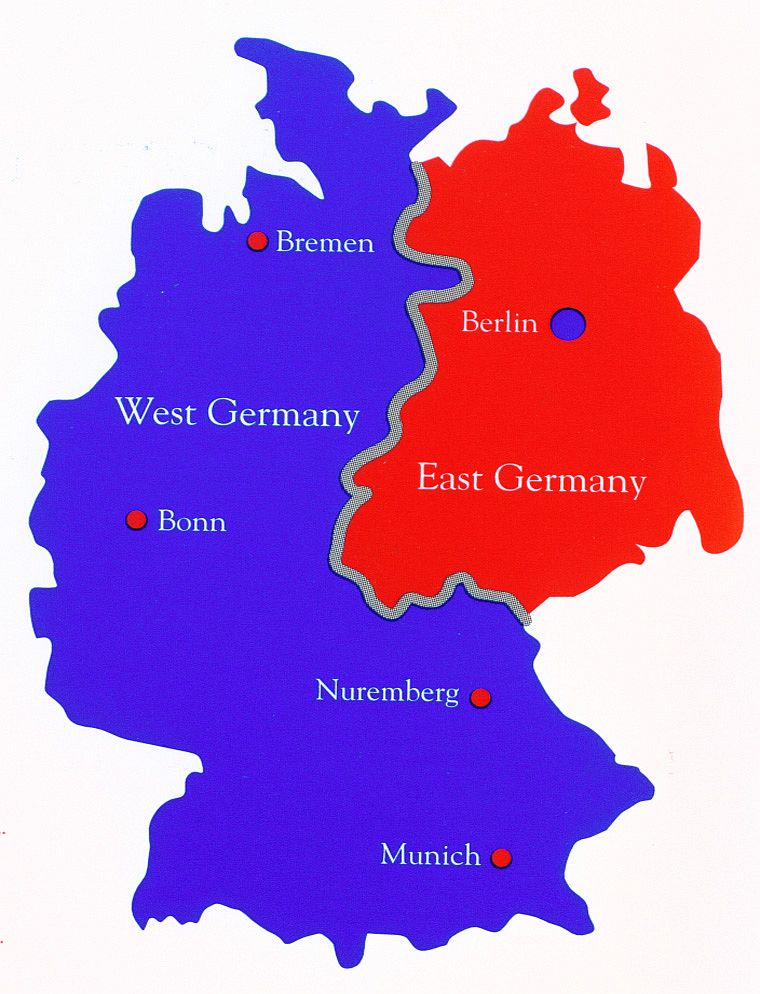
In Europe, the dividing line between East and West remained essentially frozen during the next decades. But conflict spread to Asia, Africa, and Latin America. The struggle to overthrow colonial regimes frequently became entangled in Cold War tensions, and the superpowers competed to influence anti-colonial movements.
In 1949, the communists triumphed in the Chinese civil war, and the world's most populous nation joined the Soviet Union as a Cold War adversary. In 1950, North Korea invaded South Korea, and the United Nations and the United States sent troops and military aid. Communist China intervened to support North Korea, and bloody campaigns stretched on for three years until a truce was signed in 1953.
In 1954, the colonial French regime fell in Vietnam.
The United States supported a military government in South Vietnam and worked to prevent free elections that might have unified the country under the control of communist North Vietnam. In response to the threat, the Southeast Asia Treaty Organization (SEATO) was formed in 1955 to prevent communist expansion, and President Eisenhower sent some 700 military personnel as well as military and economic aid to the government of South Vietnam. The effort was foundering when John F. Kennedy took office.
Closer to home, the Cuban resistance movement led by Fidel Castro deposed the pro-American military dictatorship of Fulgencio Batista in 1959. Castro's Cuba quickly became militarily and economically dependent on the Soviet Union. The United States' main rival in the Cold War had established a foothold just ninety miles off the coast of Florida.
Kennedy and the Cold War
Cold War rhetoric dominated the 1960 presidential campaign. Senator John F. Kennedy and Vice President Richard M. Nixon both pledged to strengthen American military forces and promised a tough stance against the Soviet Union and international communism. Kennedy warned of the Soviet's growing arsenal of intercontinental ballistic missiles and pledged to revitalize American nuclear forces. He also criticized the Eisenhower administration for permitting the establishment of a pro-Soviet government in Cuba.
John F. Kennedy was the first American president born in the 20th century. The Cold War and the nuclear arms race with the Soviet Union were vital international issues throughout his political career. His inaugural address stressed the contest between the free world and the communist world, and he pledged that the American people would "pay any price, bear any burden, meet any hardship, support any friend, oppose any foe to assure the survival and success of liberty."
The Bay of Pigs
Before his inauguration, JFK was briefed on a plan drafted during the Eisenhower administration to train Cuban exiles for an invasion of their homeland. The plan anticipated that support from the Cuban people and perhaps even elements of the Cuban military would lead to the overthrow of Castro and the establishment of a non-communist government friendly to the United States.
Kennedy approved the operation and some 1,400 exiles landed at Cuba's Bay of Pigs on April 17. The entire force was either killed or captured, and Kennedy took full responsibility for the failure of the operation.
The Arms Race
In June 1961, Kennedy met with Soviet leader Nikita Khrushchev in Vienna, Austria. (See a memorandum below outlining the main points of conversation between President Kennedy and Khrushchev at their first lunch meeting.) Kennedy was surprised by Khrushchev's combative tone during the summit. At one point, Khrushchev threatened to cut off Allied access to Berlin. The Soviet leader pointed out the Lenin Peace Medals he was wearing, and Kennedy answered, "I hope you keep them." Just two months later, Khrushchev ordered the construction of the Berlin Wall to stop the flood of East Germans into West Germany.
As a result of these threatening developments, Kennedy ordered substantial increases in American intercontinental ballistic missile forces. He also added five new army divisions and increased the nation's air power and military reserves. The Soviets meanwhile resumed nuclear testing and President Kennedy responded by reluctantly reactivating American tests in early 1962.


Comments
Post a Comment